Dear Friend,
When the early chill gathers at the threshold and the natural world withdraws its vitality to prepare for the great seasonal stillness, an ancient and quiet instinct awakens within us. Winter has never been merely a shift in temperature: across ancestral cultures throughout the world, it represents the season of testing, of dense quietude, and of the deliberate preservation of what truly matters. In an era marked by shifting global tensions, systemic uncertainty, and widespread unease, this inward call becomes essential. When turbulence commands the exterior world, scattered attention leads only to exhaustion; the true remedy is to turn inward, gather our strength, and secure an unshakable inner foundation.
Faced with dilemmas that seem insurmountable, or daily pressures clouded by excessive noise, the mind easily wears itself thin attempting to force immediate outcomes. In such moments, the discipline of archetypal forms and sacred geometry provides enduring clarity. These patterns do not offer superficial shortcuts: they serve as timeless compasses, visual frameworks of order designed to steady restless thoughts, protect resolve, and restore deliberate purpose to the will.
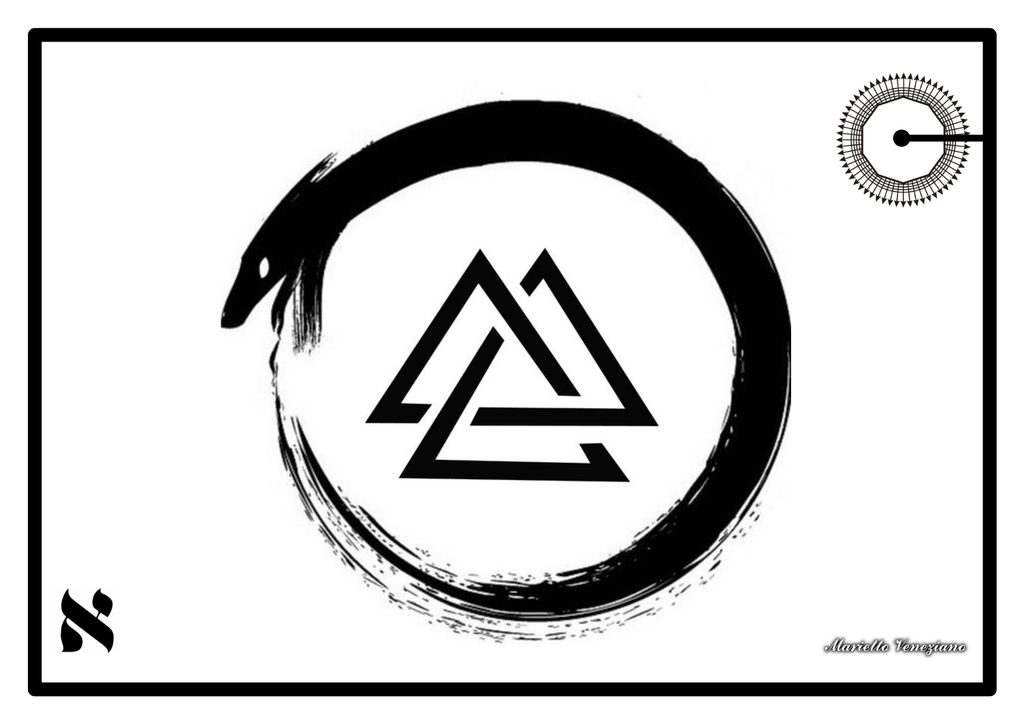
This composition by Marietto Veneziano and Ilde Garda brings together foundational elements from complementary intellectual and philosophical lineages: Northern European traditions, Hermetic philosophy, classical alphabetic metaphysics, and the precise discipline of form-study.
The Valknut: The Triad of Fortitude Before the Obstacle
Dominating the core of the composition is the Valknut, the deliberate interweaving of three equilateral triangles forming nine outward-pointing vertices. In ancient Germanic and Scandinavian lore, this symbol was never a decorative abstraction: it represented the unyielding reality of destiny, self-mastery, and the trial of conscious choice. The triangle stands as the fundamental rigid shape, naturally distributing weight and resisting deformation under external force.
Its ninefold culmination directly mirrors the cosmological structure of the nine realms, while addressing the tripartite nature of human integrity:
- The triangle of intellectual clarity, essential for discerning objective reality without succumbing to reactive fear or collective hysteria.
- The triangle of disciplined action, which channels energy into measured, constructive steps, keeping stagnation at bay when conditions turn bleak.
- The triangle of intuitive discernment, linking individual experience to enduring universal principles, anchoring the conviction that every season of trial serves a refining purpose.
When circumstances appear hopelessly knotted, the Valknut serves as an uncompromising standard of alignment. It reminds us that no meaningful challenge can be answered while thoughts, values, and actions remain at war with one another. By drawing the eye to its interlocking stability, it quiets mental friction and invites purposeful composure.
The Ouroboros: The Resilient Cycle and the Protective Boundary
Encircling and shielding the central triad is the decisive figure of the Ouroboros, the ancient serpent holding its own tail. From early Egyptian iconography through Hellenistic philosophy and beyond, this unbroken circle stands as the supreme emblem of totality, continuity, and self-renewal.
Where casual perception views time as an exhausting linear descent, timeless thought recognizes that genuine beginnings are born of deliberate completions. The Ouroboros illustrates that the deepest contraction, the starkest hour of the cold season, is precisely where the momentum of eventual renewal is quietly forged.
Drawn with the fluid resonance of a single ink stroke, its outline balances decisive boundary with organic movement. It forms an intentional perimeter, shielding focused contemplation from the disordered commotion of the outside world. Within this space, the mind regains its breath and centers upon its primary duty, assured that no season of hardship is permanent. The serpent feeding upon its origin reflects a vital reality: challenges met with steady composure become the very foundation upon which greater wisdom is built.
The Decagon: Precision, Synthesis, and Outward Directness
Positioned in the upper right, balanced against the central axis, rests an intricately measured decagon with concentric radiations and an outward directional trace. This structure reflects a cornerstone of classical form analysis.
Within numeric symbolism, the ten signifies the completion of a foundational cycle and the return to unity upon a higher plane. The decagon is historically regarded as an instrument of filtration and condensation. Its regular ten-sided geometry serves to distill an objective, clearing away lingering ambiguities, ambient distraction, and fragmented intentions.
The horizontal ray extending beyond the perimeter represents deliberate projection. Clarity within oneself remains incomplete without an avenue for realization. This line marks the decisive bridge between silent discernment and purposeful application in practical matters, directing disciplined focus straight toward the task at hand.
The Aleph: The Primordial Breath of Origin
Completing the structural harmony of the piece, set in the lower left, is the foundational letter Aleph. Signifying the unconditioned starting point, the initial breath before language, and the origin of form, it anchors the entire composition in fundamental simplicity.
While the decagon refines and directs purpose, the Aleph preserves its essential integrity. It serves as a reminder that the answer to intricate problems rarely lies in compounding complexity. True discernment often demands returning to the baseline: stripping away excess, quieting false urgencies, and rediscovering the clear, uncluttered intent that prompted the journey.
Integrating the Architecture into Daily Practice
A visual work of this nature is not intended for passive display, but as an anchor for daily poise and mental hygiene, particularly when seasonal rigor and external unrest tempt one toward distraction.
- Quiet Contemplation: Set aside a few moments at dawn or nightfall to focus calmly upon the central intersection of the triangles. Allow the breath to slow, permitting the balanced geometry to impart its calm symmetry upon scattered thoughts.
- Clarifying the Purpose: On a clean piece of parchment, state the matter requiring resolution using sober, concise language. Placing this note near the decagonal structure acts as an intentional gesture of focus, committing the concern to order, quiet deliberation, and resolve.
- Guarding the Mental Perimeter: When ambient headlines or peripheral demands threaten personal balance, mentally call upon the perimeter of the Ouroboros. Keep unhelpful clamor outside its line, guarding the interior ground where purpose, focus, and quiet strength reside.
The approaching cold season need not be met with apprehension; it may be welcomed as an instructor in discipline and resilience. Those who cultivate their inner fortress have little to fear from changing seasons or passing global storms.
For those interested in exploring the deeper historical contexts of these geometric traditions, or wishing to request a private consultation, we welcome your inquiries via direct message.