Cara amicizia,
we inhabit the most populated and simultaneously most desolate era in human history. One only needs to observe modern daily life to perceive an aching contradiction: never before have human beings been so instantaneously reachable, so visible to one another across global networks, yet never before have we felt so radically unmoored from genuine communion. Billions of digital pulses travel across fiber-optic conduits in the span of a single heartbeat. We brush against the fragmented images, thoughts, and opinions of hundreds of strangers before our feet touch the floor in the morning, yet when the night deepens and the final display goes dark, the room remains silent, cold, and heavy with an unmistakable famine of the soul.
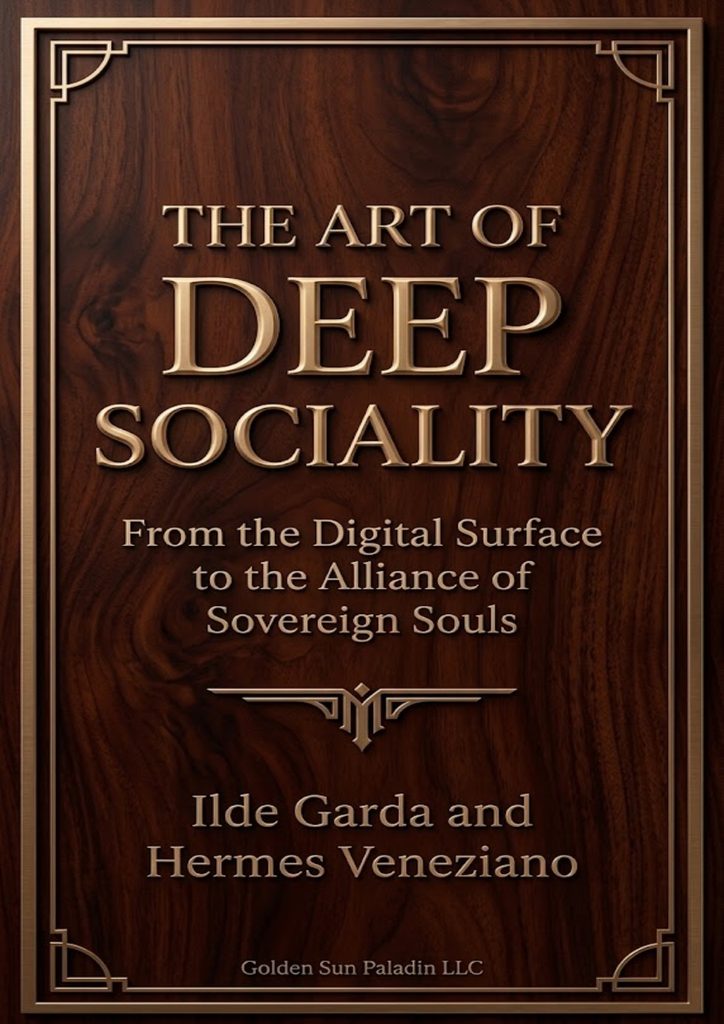
It is precisely to address this silent wound that Ilde Garda and Hermes Veneziano have released their profound work, published by Golden Sun Paladin LLC: The Art of Deep Sociality: From the Digital Surface to the Alliance of Sovereign Souls.
This work is neither an ordinary manual of superficial charm nor a collection of motivational scripts designed to expand commodified networks. It is an authentic blueprint of liberation and an unyielding manifesto for those who hear the summons of an elevated fellowship—an ecology of human bonds rooted in the density of presence, the preservation of personal wholeness, and true resonance among sovereign spirits.
The Illusion of Connection and the Attention Economy
To understand why genuine communion has evaporated, we must first examine the architecture in which modern life is enclosed. The platforms across which contemporary interactions unfold were never designed as philanthropic forums for brotherhood. They are sophisticated extractive mechanisms engineered to capture and monetize our most finite asset: our cognitive and emotional presence.
Within this framework, human connection has been dismantled into transactional micro-exchanges: the fleeting click, the craving for quantitative validation, and the reduction of nuanced human souls into flat categories and reactive comments. The living individual is no longer approached as a sacred mystery to be discovered, but consumed as content to be casually scrolled past.
The authors draw an unyielding line between connection and communion. Connection is technical, horizontal, and frictionless: it links devices and exchanges data without ever touching the core of being. Communion is vertical, organic, and transformative. It occurs only when two or more minds possess the courage to lay down their defensive armor, allowing a shared energetic field to emerge. We have traded the depth of direct living for the sterile safety of curated profiles, shrinking from real encounters out of a pervasive dread of the unscripted real. Reclaiming authentic sociality requires an act of noble discernment: pruning draining entanglements, reclaiming silence, and choosing depth over hollow volume.
The Anatomy of Solitude: From the Wasteland to the Inner Sanctuary
At the core of the book lies an investigation into the roots of modern loneliness. We find ourselves surrounded by what sociologist David Riesman identified as the lonely crowd: multitudes gathered in physical or digital contiguity, yet atomized at the deepest level of existence. Contemporary loneliness is not an absence of contact, but a famine of substance—the devastating realization of standing in a crowded room while feeling that one does not truly exist for anyone present.
Fleeing from this ache, modern individuals surround themselves with ceaseless noise, terrified of the questions that arise when silence falls. Yet fleeing the void only deepens the wound.
Ilde Garda and Hermes Veneziano illuminate a vital distinction between two opposite states: toxic isolation and fertile solitude. Toxic isolation is an endured, punishing state born of self-rejection and fear, where an individual enters relationships as an emotional beggar demanding rescue. When driven by the terror of being alone, discernment collapses: one gladly ingests emotional poison simply to escape the quiet. Fertile solitude, by contrast, is an act of sovereign mastery. It is the generative space where life experiences settle and distill, where character is tempered, and where one learns to inhabit one’s own skin. Only the individual who has cleared their internal temple can meet another without hidden demands, offering presence from an overflow of inner wholeness rather than an empty void.
The Tuning Fork Principle and Elective Resonance
For millennia, human relationships were governed by the quiet tyranny of accidental proximity: people bonded primarily with those who shared the same village, street, or workplace. Today, when technology is liberated from addictive misuse, we possess the power to decouple fellowship from physical adjacency and recognize kindred spirits across the world.
The text illustrates this dynamic through the acoustic phenomenon of sympathetic resonance. When two tuning forks calibrated to the exact same frequency stand apart and one is struck, the second begins to vibrate and sound its note spontaneously. Yet an adjacent instrument tuned to a foreign frequency remains completely silent and still. Interpersonal exhaustion occurs when we attempt to force an acoustic harmonic between instruments that simply do not share our fundamental pitch.
Elective recognition does not announce itself through frantic drama or theatrical euphoria. It reveals itself through quiet, unmistakable signatures:
- The immediate dissolution of judgment, where the mind drops its customary guard and feels no urge to defend its image.
- Semantic economy, where minimal words convey vast chapters of shared meaning without the need for endless disclaimers.
- The fertility of shared stillness, where silence between two individuals becomes nourishing, dense, and comforting.
- Unconditional energetic replenishment, leaving both souls clearer, stronger, and more resolved after an encounter.
The timeless teaching of the authors is unmistakable: do not act as an anxious hunter pursuing companions across the social landscape. Stand as a lighthouse. A lighthouse never leaves its granite foundation to chase ships along the shore; it focuses entirely on keeping its beam brilliant and pure, naturally guiding aligned vessels into harbor while warning away the rest.
The Binary Star Architecture and the Relational Sanctuary
True relational maturity requires energetic discipline. Popular culture often glorifies overwhelming initial intensity, mistaking the collision of unresolved wounds for spiritual destiny. Real compatibility resembles the arrival of dawn: it brings a deep muscular release, steady breath, and grounded calm.
The authors present the archetype of binary star systems: two suns orbiting a shared center of gravity, jointly illuminating the space around them. Neither star collapses into the other to consume it, and neither surrenders its internal nuclear fire. Each preserves an independent, sovereign orbit. In authentic alliances, your center of gravity remains inviolate; you share a higher purpose, but each maintains their own vertical axis.
To protect this sacred bond from the noise of the outside world, we must build protected sanctuaries. The book revives the classical concept of the Témenos: the sacred enclosure deliberately carved out from profane use. An authentic relational sanctuary rests upon four unyielding pillars: total technological exile to preserve undivided focus, the hermetic seal of absolute confidentiality, the suspension of critical verdicts, and the symmetry of shared vulnerability.
Within such sanctuaries, intentional communities take shape like the colonnade of a classical temple: upright pillars, each resting upon its own foundation of rock, standing proudly together to support the architrave of a transcendent vision.
Ontological Listening and the Magnetism of Radical Transparency
In its practical dimension, the work guides the reader through the disciplines of living dialogue. It dismantles the charade of modern conversation, where people merely wait for their turn to speak, and introduces ontological listening. This is the practice of relational kénosis—deliberately emptying the mind of personal biographies, credentials, and advice to become an undisturbed witness to the reality of the other.
This presence is grounded in precise protocols: the three-second rule of deliberate silence before replying, the practice of the golden mirror to reflect the emotional essence of the speaker, and maieutic inquiry that empowers the other to find their own sovereign resolution.
Complementing this posture is radical transparency. Laying down the armor of invulnerability is not a surrender of strength, but the ultimate magnetic power. Speaking unvarnished truth acts as an immediate weedkiller against manipulators and predators, who thrive solely in ambiguity and fear. It naturally drives away those seeking compliant mirrors, while attracting the unbreakable allegiance of upright souls.
Where to Acquire the Work: Choosing Your Portal
Cara amicizia, if you feel the resonance of this journey and wish to immerse yourself in the complete volume, The Art of Deep Sociality is available across multiple avenues.
While the edition can be found within major international catalogs such as Amazon and Google Play Books, the most harmonious and direct channel to welcome this work is through our dedicated library on Gumroad.
Choosing Gumroad represents the purest way to support our independent research directly, granting you immediate access to the complete digital text, operational protocols, and unedited materials without intermediaries.
You can enter our library and secure your copy through our direct portal:
Access the complete edition on Gumroad
Whichever threshold you choose to cross, may these pages serve as an enduring stronghold of clarity, personal sovereignty, and elevated fellowship along your path.